

-
Contents
Ceramic and steel knives both have benefits and drawbacks. Let's help you choose.
Ceramic Knives: Pros and Cons
Ceramic knives have become a staple in modern kitchens thanks to their light weight and impressive sharpness. Popularized in particular by the Japanese brand Kyocera, they are made from zirconium oxide, an extremely hard material obtained after firing at very high temperatures. This hardness gives them unique qualities, but also certain limitations that are important to know before making a choice.
One of the main advantages of a ceramic knife is its exceptional sharpness. The blade is much harder than most steels used in cutlery, making it extremely sharp. It provides a clean, precise, and consistent cut when slicing fruits, vegetables, or boneless meats at home. This also means virtually no need for sharpening, a significant advantage for users who do not wish to maintain their tools regularly.
Furthermore, a ceramic knife is significantly lighter than a steel model, making it comfortable to handle and reducing fatigue during prolonged cutting. This feature makes it particularly appealing for beginner cooks or for simple everyday use.

Ceramic also has the advantage of being completely rust-proof. It does not rust, does not oxidize, and is fully resistant to acidic foods such as lemons. Furthermore, it is food-safe. It does not transfer any taste or odor to food and limits oxidation, which helps keep cut fruits and vegetables looking fresh for longer.
However, this high hardness has a downside. Ceramic is a fragile material when subjected to impacts and lateral forces. Even in experienced hands, it is not uncommon to see chips appear along the edge after just a few months of use. This phenomenon is not necessarily due to rough handling. It is explained by the very nature of the material. Unlike steel, which can deform slightly under stress, ceramic does not bend. It breaks or chips. Simple repeated micro-impacts, a cutting board that is too hard, or a slight twisting motion at the end of a cut can be enough to create small chips that are invisible at first but gradually degrade the quality of the edge.
Finally, sharpening a ceramic knife is more complex than sharpening a steel knife. Due to its extreme hardness, it requires specific diamond-based tools or returning it to the manufacturer. This can represent an additional cost and an inconvenience for users accustomed to sharpening their own blades.
Steel Knives: Pros and Cons
Steel knives are the traditional standard in cutlery and remain the most widely used in both professional and home kitchens today. Unlike ceramic models, they are made from metal alloys whose composition can vary significantly depending on the manufacturer.
One of the main advantages of a steel knife is its resistance to impacts and the stresses of daily use. Steel has a certain flexibility that allows it to absorb micro-impacts without cracking. This makes it suitable for intensive professional use and a wide variety of kitchen tasks. Unlike ceramic, it better withstands pressure, slight twisting motions, and cutting denser foods.
Another significant advantage is how easy they are to sharpen. Steel knives can be sharpened almost indefinitely using common tools such as a whetstone or sharpening steel, allowing you to quickly restore their sharpness. For users who enjoy maintaining their knives themselves, this is a major advantage, as it allows you to significantly extend the blade’s lifespan.
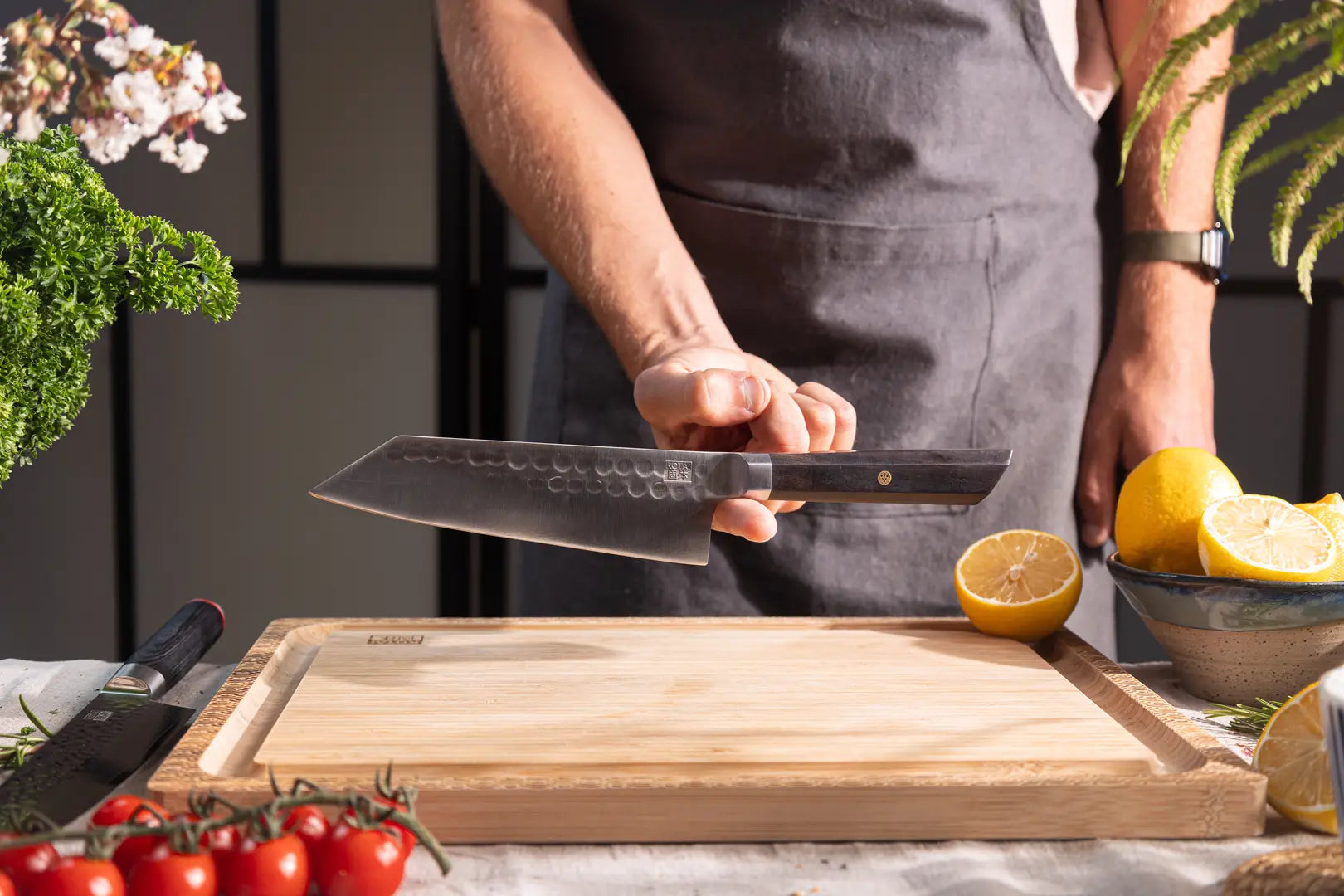
However, not all steels are created equal. Some entry-level knives use relatively soft alloys that lose their edge quickly. In contrast, high-quality knives often use high-carbon stainless steels. This type of alloy combines two qualities highly valued in the kitchen. The presence of carbon enhances the blade’s ability to maintain a long-lasting edge, while chromium ensures good corrosion resistance.
This is why KOTAI uses Japanese stainless steels from Aichi Steel and Takefu. These steels, combined with cryogenic treatment, allow KOTAI knives to achieve a hardness of 57 to 61 ±1 on the Rockwell scale. This level of hardness means the blade retains its sharpness longer while remaining durable enough for daily use.
Steel does, however, have a few drawbacks. Depending on its composition, it may require some maintenance to prevent oxidation and maintain optimal sharpness. It also needs regular sharpening to remain effective. Finally, steel knives are generally a bit heavier than their ceramic counterparts, which can be noticeable during long preparation sessions.
In short, a steel knife remains the most versatile and durable option for everyday kitchen use. When made from high-carbon stainless steel and properly finished, it offers an excellent balance of durability, ease of maintenance, and cutting performance.
Comparison: Steel Knife vs. Ceramic Knife
Comparing a steel knife to a ceramic knife is primarily a comparison of two different approaches to kitchen performance. Ceramic focuses above all on extreme hardness and total resistance to oxidation, while steel generally seeks to strike a balance between sharpness, durability, and versatility.
When it comes to sharpness, ceramic knives are often very impressive right out of the box. Their high hardness allows them to retain their edge for a long time without requiring frequent sharpening. Steel knives, on the other hand, require slightly more regular maintenance. However, when made with high-quality steels, they can also offer excellent edge retention.
Durability is one of the most significant differences between these two materials. Ceramic is extremely hard but relatively brittle when subjected to impacts and lateral stress. Even with careful use, small chips may appear on the blade over time. Steel, on the other hand, possesses a certain elasticity that allows it to absorb micro-impacts and pressure without cracking. This property makes steel knives much more resilient to everyday use.
Versatility also works in steel’s favor. A steel knife can be used for a wide range of kitchen tasks, including cutting firmer or more challenging foods. Ceramic knives are generally more specialized. They excel at cutting fruits, vegetables, and boneless foods, but they are less suited for tasks requiring greater strength.
Finally, maintenance is a notable point of difference. Ceramic knives do not rust and retain their sharpness for a long time, but when they need to be sharpened, the process is more complex and often requires specific tools. Steel knives, on the other hand, require more regular sharpening, but this can be easily done with a whetstone or sharpening steel. With modern stainless steel, the risk of corrosion is also limited if the knife is properly maintained.
To summarize
Ultimately, the choice between a steel knife and a ceramic knife depends mainly on the user’s intended use and personal preferences. Ceramic knives appeal for their long-lasting sharpness and light weight, while steel remains the most versatile and durable option for a wide range of everyday tasks. High-quality steel knives, particularly those made from high-performance Japanese steels such as those produced by Aichi Steel, now offer an excellent balance between cutting performance, durability, and ease of maintenance.
More Articles
-

How to Determine the Hardness of Knife Blades: ...
Is a harder blade necessarily better? Here's everything you need to know.
How to Determine the Hardness of Knife Blades: ...
Is a harder blade necessarily better? Here's everything you need to know.
-

Which Knife Should You Choose: Steel Knife vs C...
Ceramic and steel knives both have benefits and drawbacks. Let's help you choose.
Which Knife Should You Choose: Steel Knife vs C...
Ceramic and steel knives both have benefits and drawbacks. Let's help you choose.
-

Which grind is best for my kitchen knife?
The grind refers to the way the blade has been gradually thinned from the spine down to the cutting edge. This geometry plays a crucial role in the knife’s performance. The...
Which grind is best for my kitchen knife?
The grind refers to the way the blade has been gradually thinned from the spine down to the cutting edge. This geometry plays a crucial role in the knife’s performance. The...


